A factory battery storage system should be sized for the power it must supply and the energy it must deliver during the intended operating window. Total daily electricity consumption alone does not determine the right battery capacity. A system for peak shaving may serve a small part of the factory load, while full-facility backup requires a much larger installation. For example, delivering 500 kW for two hours requires 1,000 kWh of AC energy. The installed nominal battery capacity must also account for the usable energy window, losses and any future capacity requirement. Another factory may need several MWh for a longer event.
This guide explains how to calculate industrial battery storage capacity, compare different factory requirements, and choose a practical system size without paying for unnecessary capacity.
There is no single battery size that works for every factory.
The required capacity depends on what the facility wants the battery to do. For example, a factory using battery storage to reduce electricity demand charges may only need enough energy for one or two hours of peak production. A factory requiring emergency backup for critical equipment may need several hours of stored electricity. A solar-powered industrial facility may need greater energy capacity to store daytime generation for evening operations.
The following examples show how storage requirements change with the application.
| Factory Application | Required Power | Discharge Duration | Delivered Energy Required |
|---|---|---|---|
| Small workshop peak shaving | 100 kW | 2 hours | 200 kWh |
| Medium factory peak shaving | 300 kW | 2 hours | 600 kWh |
| Manufacturing plant energy shifting | 500 kW | 3 hours | 1,500 kWh |
| Large industrial facility | 1,000 kW | 4 hours | 4,000 kWh |
| Critical production backup | 200 kW | 4 hours | 800 kWh |
These are illustrative application scenarios, not fixed capacity recommendations or measured factory projects. The figures represent electricity delivered to the loads before allowing for system losses, usable battery capacity limits, or long-term degradation. For accurate sizing, engineers must evaluate the facility's electricity consumption and power demand separately. Modern commercial and industrial battery energy storage systems provide modular storage configurations that can be selected according to the power and energy needs of an industrial site.
Several factors determine the required capacity of a factory battery energy storage system. The most important are peak power demand, operating duration, energy consumption patterns, and the intended application.
Peak demand for billing is usually the highest average power recorded over the utility's specified measurement interval. Instantaneous equipment starting loads should be assessed separately.
It is measured in kilowatts (kW) or megawatts (MW).
For example, a factory may normally consume 800 kW but reach 1,200 kW when several production lines operate simultaneously.
If the factory wants to limit grid demand to 900 kW, the battery must supply the difference:
1,200 kW − 900 kW = 300 kW.
The required battery discharge power is therefore at least 300 kW under this simplified condition. However, knowing the required power does not tell us how much energy the battery must store.
The length of the demand peak is equally important.
Some factories experience short demand peaks lasting 15-30 minutes.
Others operate heavy equipment at high demand for several hours.
Consider two facilities that both require 300 kW of battery output.
Factory A needs 300 kW for one hour.
Factory B needs 300 kW for four hours.
Their energy requirements are:
Factory A: 300 kW × 1 hour = 300 kWh.
Factory B: 300 kW × 4 hours = 1,200 kWh.
Although their required discharge power is identical, Factory B needs four times as much delivered energy.
This is why battery sizing must consider both kW and kWh.
A factory's total daily electricity consumption helps engineers understand its operating pattern.
For example, a manufacturing facility using an average of 600 kW over 16 operating hours consumes:
600 kW × 16 hours = 9,600 kWh per day.
However, this does not mean the factory needs a 9,600 kWh battery.
If the battery is only intended to reduce two hours of peak electricity demand, a much smaller system may be sufficient. Sizing batteries based only on daily electricity consumption can result in unnecessary investment.
Factories may need backup electricity for selected equipment during grid interruptions. Common critical loads include control systems, essential pumps, safety equipment, and certain production processes. Instead of powering the entire facility, a backup battery may serve only these loads. For example, a factory consuming 1,000 kW during normal operation may have critical loads totaling only 250 kW.
If those loads require two hours of backup power:
250 kW × 2 hours = 500 kWh.
The final installed capacity must account for system efficiency, operating reserve, and battery degradation. A battery used for backup also requires an electrical configuration capable of safely supplying the selected loads during an outage.
Factories with rooftop solar panels may use batteries to store excess electricity during the day. However, the required capacity depends on how much solar energy is available and when the factory needs it. For example, a facility may generate 1,000 kWh of surplus solar electricity during the afternoon. If evening operations require only 600 kWh of that energy, installing enough storage for the full 1,000 kWh may not provide additional value. Solar production data and hourly factory consumption should be compared before selecting battery capacity.
The basic factory battery storage sizing formula is:
Required Delivered Energy (kWh) = Battery Discharge Power (kW) × Discharge Duration (hours)
This provides the amount of electricity the system must deliver.
To estimate nominal battery capacity, engineers also need to consider usable battery energy and system losses.
A simplified formula is:
Nominal Battery Capacity (kWh) = Required AC Energy (kWh) ÷ (Usable Capacity Fraction × Discharge Efficiency)
For a project that must still meet its energy target after years of operation, an additional battery degradation allowance is required.
The following example shows the calculation.
Assume a medium-sized factory has the following electricity demand:
Normal operating load: 700 kW
Maximum recorded load: 1,100 kW
Target maximum grid demand: 800 kW
The battery must provide:
1,100 kW − 800 kW = 300 kW.
This is the initial discharge power requirement.
Assume the factory needs a constant 300 kW reduction throughout a three-hour high-demand period. For a varying load, calculate the energy above the target separately in each billing interval and add those intervals; multiplying the largest excess by the whole window may overestimate energy needs.
Required delivered energy:
300 kW × 3 hours = 900 kWh.
The battery must therefore deliver 900 kWh to the facility during the peak period.
Battery systems normally operate within defined state-of-charge limits. Depth of discharge (DoD) indicates the share of stored battery energy discharged during a cycle. For this example, assume the system is designed around a usable capacity fraction of 90%.
Also assume a discharge-path efficiency of 95%.
These are illustrative design assumptions, not guaranteed specifications for a particular battery product.
Nominal capacity:
900 kWh ÷ (0.90 × 0.95) = 1,053 kWh.
The initial estimate is approximately 1.05 MWh of nominal battery capacity.
Battery capacity decreases over time.
Suppose the project requires full performance at a planned end-of-life capacity retention of 80%.
The capacity calculation becomes:
900 kWh ÷ (0.90 × 0.95 × 0.80) = 1,316 kWh.
Under these assumptions, approximately 1.32 MWh of initial nominal battery capacity would be needed to deliver the target energy at the specified end-of-life condition. This is a simplified planning calculation. The final design must use the product's warranted degradation curve, operating limits, temperature assumptions, and available power at end of life.
Battery capacity alone does not determine how much power the system can deliver. The power conversion system (PCS) must support the required discharge power. In this example, the factory needs at least 300 kW of usable AC discharge power during the specified period. The selected PCS must also meet site voltage, power factor, thermal derating, and overload requirements.
The final specification therefore includes both:
Required AC discharge power: 300 kW.
Estimated initial nominal battery energy: approximately 1.32 MWh for the stated end-of-life assumptions.
This is a preliminary sizing result, not a complete equipment design.
Different industrial processes create different electricity demand patterns. The following scenarios show how battery sizing changes across manufacturing applications.
Food processing plants often operate refrigeration equipment, compressors, and production machinery. Refrigeration may run continuously, while production equipment creates additional daytime demand peaks. Battery storage can help reduce peak grid demand or support selected critical refrigeration loads. For example, a cold storage facility may need 200 kW of battery power for three hours.
Required delivered energy:
200 kW × 3 hours = 600 kWh.
The installed battery capacity would need to exceed 600 kWh after accounting for usable state-of-charge limits and losses. If backup operation is required, engineers must also consider compressor starting currents, load sequencing, and the necessary backup electrical infrastructure.
Metal processing facilities may operate heavy motors, welding equipment, cutting systems, and other high-power machines. Some equipment creates short power peaks, while other processes require sustained high output. Suppose a factory needs to reduce grid demand by 500 kW for two hours.
Required delivered energy:
500 kW × 2 hours = 1,000 kWh.
A battery system rated for at least 500 kW of AC discharge power would be required, with sufficient usable energy to cover the full period. Motor starting currents and rapid load changes must be checked separately from average electricity demand.
Textile factories may have extended operating hours with relatively stable base loads. Battery storage can shift part of the electricity purchased during expensive tariff periods to lower-cost periods. Suppose a textile factory needs 400 kW of battery output during a four-hour peak tariff window.
Required delivered energy:
400 kW × 4 hours = 1,600 kWh.
The project may require more than 1.6 MWh of nominal battery capacity depending on system efficiency, operating reserves, and degradation requirements.
Electronics manufacturing facilities often operate sensitive production equipment and automated control systems. Battery storage may support electricity cost management and selected backup requirements. However, backup applications must be designed around acceptable interruption times. A facility requiring uninterrupted power for sensitive equipment may still need a dedicated UPS, even when a larger battery energy storage system is installed. The energy storage system and UPS should be coordinated as part of the overall electrical design.
A factory with a peak electricity demand of 1 MW does not necessarily need a 1 MW battery. The required battery size depends on how much of the factory load must be supplied and for how long.
Consider a facility with a maximum grid demand of 1,000 kW.
If the goal is to reduce grid demand by 20%, the battery must provide 200 kW.
Different discharge durations produce different energy requirements.
| Discharge Duration | Battery AC Output | Required Delivered Energy |
|---|---|---|
| 1 hour | 200 kW | 200 kWh |
| 2 hours | 200 kW | 400 kWh |
| 3 hours | 200 kW | 600 kWh |
| 4 hours | 200 kW | 800 kWh |
| 6 hours | 200 kW | 1,200 kWh |
These figures show the minimum delivered energy requirement before losses and reserve allowances. If the factory wants full-load backup instead of a 20% demand reduction, the requirements are much larger. For example, supplying 1 MW for four hours requires 4 MWh of delivered electricity before accounting for system losses. This difference is why every industrial energy storage project should begin with a clearly defined operating objective.
Industrial battery storage products are available in different cabinet sizes and system configurations. The appropriate equipment depends on required nominal energy, usable energy, discharge power, and the installation layout. For example, HiTHIUM offers liquid-cooled LFP battery cabinets including the ∞Block 261kWh and ∞Block 418kWh.
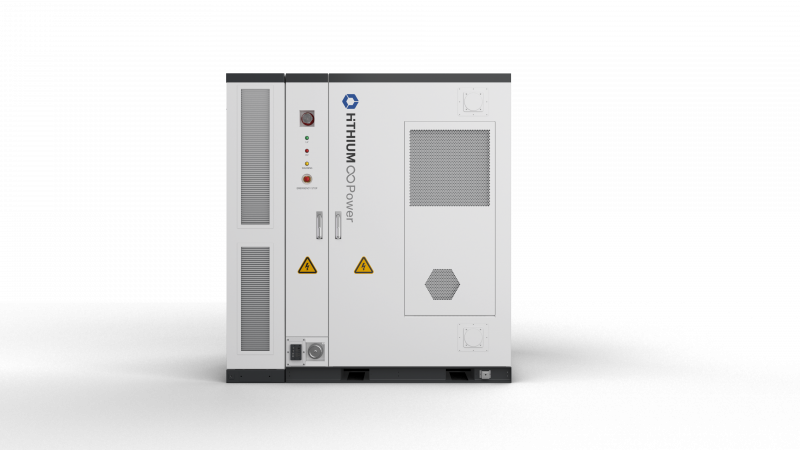
The product range also includes the ∞Power 1022kWh cabinet.
These capacities provide options for industrial storage projects, but cabinet energy capacity alone does not determine output power or guaranteed runtime. Consider the earlier example requiring at least 1,316 kWh of initial nominal energy to deliver 900 kWh at the assumed end-of-life condition. The following cabinet counts exceed that nominal-energy threshold. They are arithmetic comparisons, not engineered project configurations.
Different combinations may be considered.
| Battery cabinet configuration | Combined nominal energy |
|---|---|
| Six 261 kWh cabinets | 1,566 kWh |
| Four 418 kWh cabinets | 1,672 kWh |
| Two 1022.72 kWh cabinets | 2,045.44 kWh |
These calculations use rounded published cabinet energy ratings. They compare nominal energy only and do not establish equipment compatibility, PCS power, minimum installation size, usable AC energy, or guaranteed project performance. A slightly larger installation may be appropriate when future expansion or additional energy reserve is required. However, oversized storage increases initial investment and may leave battery capacity unused. Buyers can review the specifications of HiTHIUM C&I battery storage products when comparing cabinet capacities, cooling methods, and installation requirements.
Correct battery sizing affects project economics, operating flexibility, and long-term performance.
Battery capacity is a major contributor to project equipment cost.
Installing 2 MWh when a factory only needs 1 MWh may create additional costs without proportional savings. The extra capacity may also require more installation space and supporting electrical equipment.
An undersized battery may run out of usable energy before the peak period ends. For example, a factory requiring 400 kW for three hours needs 1,200 kWh of delivered electricity. A system capable of delivering only 800 kWh could maintain the full 400 kW output for just two hours under idealized conditions. The remaining peak demand would still need to be supplied by the grid.
Battery sizing affects how frequently and deeply the system cycles.
A system that repeatedly reaches its operating limits may experience a different degradation pattern from one operating at lower depth of discharge.
However, adding extra capacity is not always the best solution.
The battery's actual degradation characteristics, operating schedule, and project economics must be considered together.
Factories may install additional production lines or expand operating hours.
These changes increase electricity demand.
A modular battery system can make phased expansion possible, provided the electrical infrastructure, controls, and equipment design support it. Project owners should identify planned production changes before finalizing the initial storage design.
Compare candidate sizes using the actual electricity tariff and an interval dispatch model. A larger battery may shift more energy but will not necessarily reduce the highest billed demand further. Include charging energy, operating costs and capacity degradation, and check whether any backup reserve reduces the energy available for everyday savings. Evaluate both power-related equipment costs and energy capacity. Once the technically suitable sizes are established, use their modeled annual net benefits and lifecycle cash flows to compare the investment.
HiTHIUM's C&I catalogue describes a project in the Czech Republic using 42 units of the 125kW/261kWh all-in-one configuration. The reported scale is 5.25 MW/10.962 MWh, consistent with the combined nominal ratings of those units. The listed applications are electricity arbitrage and electricity cost reduction. The reference illustrates how cabinets can be deployed across a larger project. The number of units for a new factory must still follow its required AC output, usable energy, site integration and reserve requirements.
Several mistakes can reduce the value of an industrial battery storage investment.
A factory consuming 10 MWh per day does not automatically need a 10 MWh battery. Capacity should be based on the energy the battery must actually deliver.
Two factories with the same peak load can require different battery capacities if their peak periods have different lengths.
A 1,000 kWh nameplate battery does not necessarily deliver 1,000 kWh of AC electricity under every operating condition.
A large battery cabinet may store enough energy but lack the required discharge power unless it is paired with a suitable PCS.
A system designed only around initial capacity may fail to meet the required runtime near the end of its service life.
Grid-connected battery storage does not automatically provide power during an outage. Backup operation must be supported by the required electrical design, controls, and protective equipment. Avoiding these mistakes can improve the accuracy of industrial battery storage sizing and reduce unnecessary project costs.
HiTHIUM offers the ∞Block 125kW/261kWh all-in-one configuration, the ∞Block 418kWh DC battery cabinet and the ∞Power 1022kWh battery cabinet. A 418kWh or 1022kWh project can be developed with a matched external PCS through coordination with PCS manufacturers. Explore the HiTHIUM C&I battery storage product range and commercial and industrial energy storage solutions when comparing configurations.
Contact HiTHIUM with your interval load data, tariff, target demand limit, required backup duration and available installation area to discuss a suitable configuration.
Previous: None
Next: What Should You Look for in a Golf Cart Battery Manufacturer?


Comments
Please Join Us to post.
0